
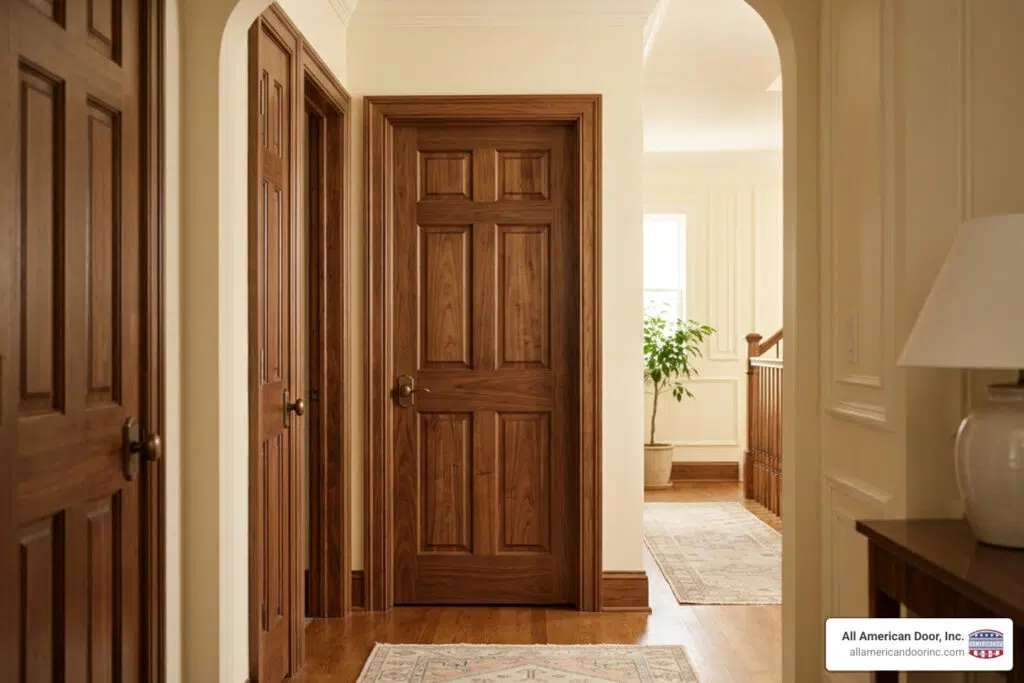
Why 4 Panel Wood Doors Remain a Top Choice for Interior Upgrades
4 panel wood doors are one of the most versatile and timeless interior door styles you can choose for your home. Whether you’re updating a bedroom, hallway, or living space, they offer a classic look that works across traditional, craftsman, and transitional design styles.
Quick answer — what to know about 4 panel wood doors:
| Feature | What to Expect |
|---|---|
| Panel styles | Raised, flat/shaker, or tongue-and-groove |
| Wood species | Poplar, pine, oak, maple, walnut, and more |
| Finish options | Paint-grade (primed) or stain-grade (raw wood) |
| Construction | Solid wood stile-and-rail or engineered core |
| Sizes | Standard (e.g., 30×80″) and fully custom |
| Price range | ~$150 at big-box stores to $3,000+ from specialty makers |
| Installation | Available as slab-only or prehung units |
For homeowners in coastal areas like Orange County, where humidity and salt air can wear on interior finishes, choosing the right construction and wood species makes a real difference in how long your doors look and perform.
This guide walks you through everything — from construction quality and wood species to sizing, finishing, and where to buy.
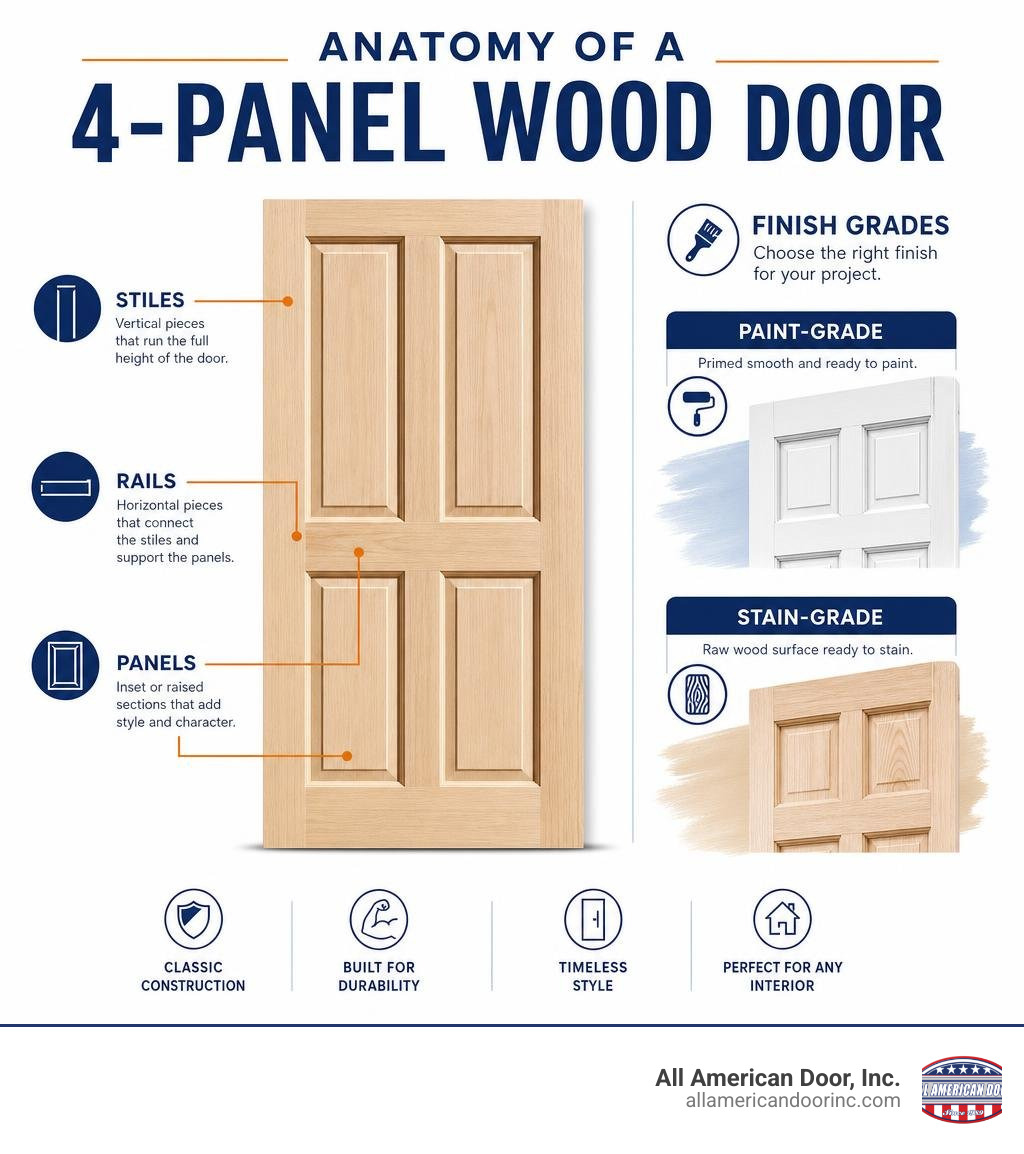
Core Construction: What Makes 4 Panel Wood Doors Durable?
When shopping for 4 panel wood doors, the beauty you see on the outside is only as good as the engineering on the inside. Traditional doors are not just flat pieces of wood; they are assemblies of multiple parts designed to work together. The gold standard of wood door manufacturing is stile-and-rail construction.
Stile-and-rail construction uses vertical boards (stiles) and horizontal boards (rails) to frame the individual wooden panels. This traditional joinery method—often utilizing robust mortise-and-tenon joints—allows the wood panels to expand and contract naturally with changes in temperature and humidity without putting stress on the door’s frame. This is incredibly important for homes in Southern California and Arizona, where we experience drastic climate differences, from coastal moisture in Orange County to dry desert heat in Lake Havasu City.
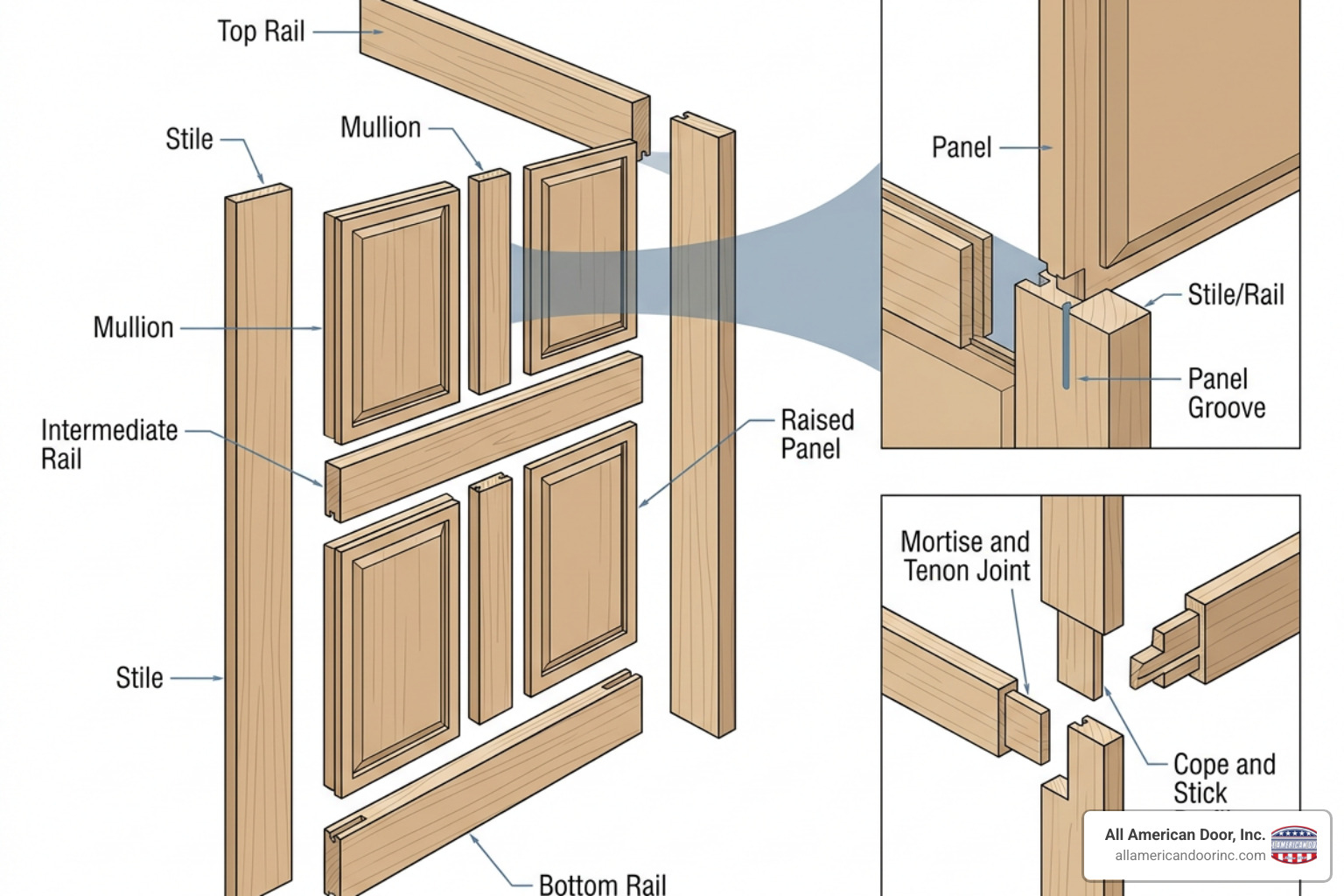
Understanding how a door is constructed helps you choose the right balance of durability, sound insulation, and warp resistance.
Solid Wood vs. Engineered Core
When selecting your doors, you will generally choose between two primary construction methods: solid wood and engineered core.
- Solid Wood Construction: These doors are made from solid pieces of timber milled and assembled into stiles, rails, and panels. They offer unmatched weight, authentic wood grain, and a premium feel. Brands like Simpson Doors: Crafted Custom Wood Doors | Since 1912 have built a century-long reputation on this high-end craftsmanship. Solid wood doors can be sanded down and refinished multiple times over their lifespan, making them a true lifetime product. However, because wood is hygroscopic, solid wood doors are more susceptible to minor warping or swelling if exposed to high moisture.
- Engineered Solid Core Construction: To combat warping while maintaining the heavy feel of real wood, many modern manufacturers use an engineered core. These doors feature a core made of engineered wood (like MDF or a cross-grained hardwood composite core) laminated with a thick veneer of real stain-grade wood on the outside. This cross-grain pattern bonded under heat and pressure creates a highly stable door that resists warping, cracking, and splitting.
Both options offer excellent soundproofing compared to cheap hollow-core doors. If you are looking to block noise between bedrooms, home offices, and living rooms, investing in solid or engineered core doors is one of the best upgrades you can make. If you are still on the fence about whether it is time to upgrade, check out these 4 Reasons to Get Replacement Doors to see how new doors improve energy efficiency and noise control.
Specialty Manufacturers vs. Big-Box Retailers
While you can easily browse home improvement centers and find standard 4-panel doors, there is a substantial difference in quality, customization, and longevity when comparing mass-produced doors to those from specialty manufacturers.
- Big-Box Retailers: Major retailers offer convenience and low entry-level pricing. You can find basic, mass-produced 4-panel doors starting around $150. However, these are often hollow core or use very thin veneers over low-density composite cores. Customization options are extremely limited, and you are generally restricted to standard sizes and basic wood species like pine.
- Specialty Manufacturers & Custom Builders: Specialty doors—such as a custom Wood 4 Panel Interior Door – Dalmatian Doors —focus on premium, thicker materials (often 1.5 inches to 1-3/4 inches thick), precise joinery, and a massive selection of wood species. Working with a local, custom door company like us at All American Door, Inc. ensures you get certified in-house installers, hands-on help in a physical showroom, and access to custom sizing that big-box stores simply cannot accommodate.
Paint-Grade vs. Stain-Grade: Species, Finishes, and Costs
One of the first decisions you need to make is whether you want to paint your doors or showcase the natural beauty of the wood grain with a stain. This decision dictates the wood species you should buy and has a major impact on your overall budget.
| Feature | Paint-Grade Doors | Stain-Grade Doors |
|---|---|---|
| Primary Material | Poplar, MDF, or primed Pine | Douglas Fir, Oak, Maple, Walnut, Cherry, Alder |
| Surface Finish | Smooth, uniform, primed white | Raw wood with natural grain variations |
| Cost | Budget-friendly (Poplar starts ~$595 from custom makers) | Mid to High (Douglas Fir starts ~$1,095; Walnut/Oak higher) |
| Maintenance | Low (easy to wipe clean, simple paint touch-ups) | Moderate (may require periodic resealing or oiling) |
| Best For | Modern, Craftsman, or colorful interiors | Traditional, rustic, or high-end architectural homes |
Choosing the Right Wood Species for 4 Panel Wood Doors
The species of wood you select determines how the door reacts to finishes and how much it will cost.
- Poplar: The absolute favorite for paint-grade applications. Poplar is a solid hardwood with a tight, uniform grain. Because it is a hardwood, it is much more dent-resistant than pine, making it perfect for high-traffic family homes. Paint-grade poplar doors typically ship primed white and ready for a flawless topcoat.
- Pine: A classic, budget-friendly choice. Pine is a softer wood that works well for both paint and rustic light stains. Knotty pine is highly sought after for cabin or rustic aesthetics, though it must be sealed properly to prevent sap from bleeding through the finish.
- Douglas Fir: Known for its remarkably straight grain and warm, reddish-tan hue. Douglas fir is incredibly strong and stable, making it a premium choice for stain-grade Craftsman-style doors.
- Oak (Red & White): Oak is famous for its prominent, heavy grain patterns and exceptional durability. White oak, in particular, has become highly popular in modern organic and transitional interior designs.
- Walnut & Maple: These are ultra-premium hardwoods. Walnut offers rich, dark, chocolate-brown tones, while maple provides a hard, dense, light-colored surface with a subtle grain pattern.
To get a better idea of how different materials fit into your remodeling plans, read our guide on Custom Doors for Every Budget: What to Expect.
Finishing and Maintenance Best Practices
To protect your investment and maintain your manufacturer’s warranty (which is typically a 1-year limited warranty for wood doors), proper finishing is non-negotiable.
- Paint-Grade Prep & Finishing: Even if a door arrives primed, it should be lightly sanded with 120- to 220-grit sandpaper to remove any dust or scuffs from transit. Apply a high-quality primer if there are raw wood edges, followed by two coats of premium interior semi-gloss or satin paint. Oil-based or high-quality acrylic latex paints are highly recommended for durability and easy cleaning.
- Stain-Grade Prep & Finishing: Stain-grade doors ship as raw wood. Before staining, apply a pre-stain wood conditioner—especially on softwoods like pine—to prevent splotchiness. Use a high-quality stain followed by at least two coats of clear polyurethane or varnish to seal the wood from moisture.
- The Six-Side Rule: You must finish all six sides of the door—front, back, left edge, right edge, top, and bottom. Skipping the top and bottom edges leaves the raw wood exposed to rising moisture, which can cause warping over time.
For more tips on choosing the perfect finish and door type for your home’s layout, see How to Choose the Right Custom Door for Your Entryway.
Customization: Profiles, Sizing, and Slab vs. Prehung
A major benefit of choosing 4 panel wood doors is the sheer number of design profiles and custom configurations available.
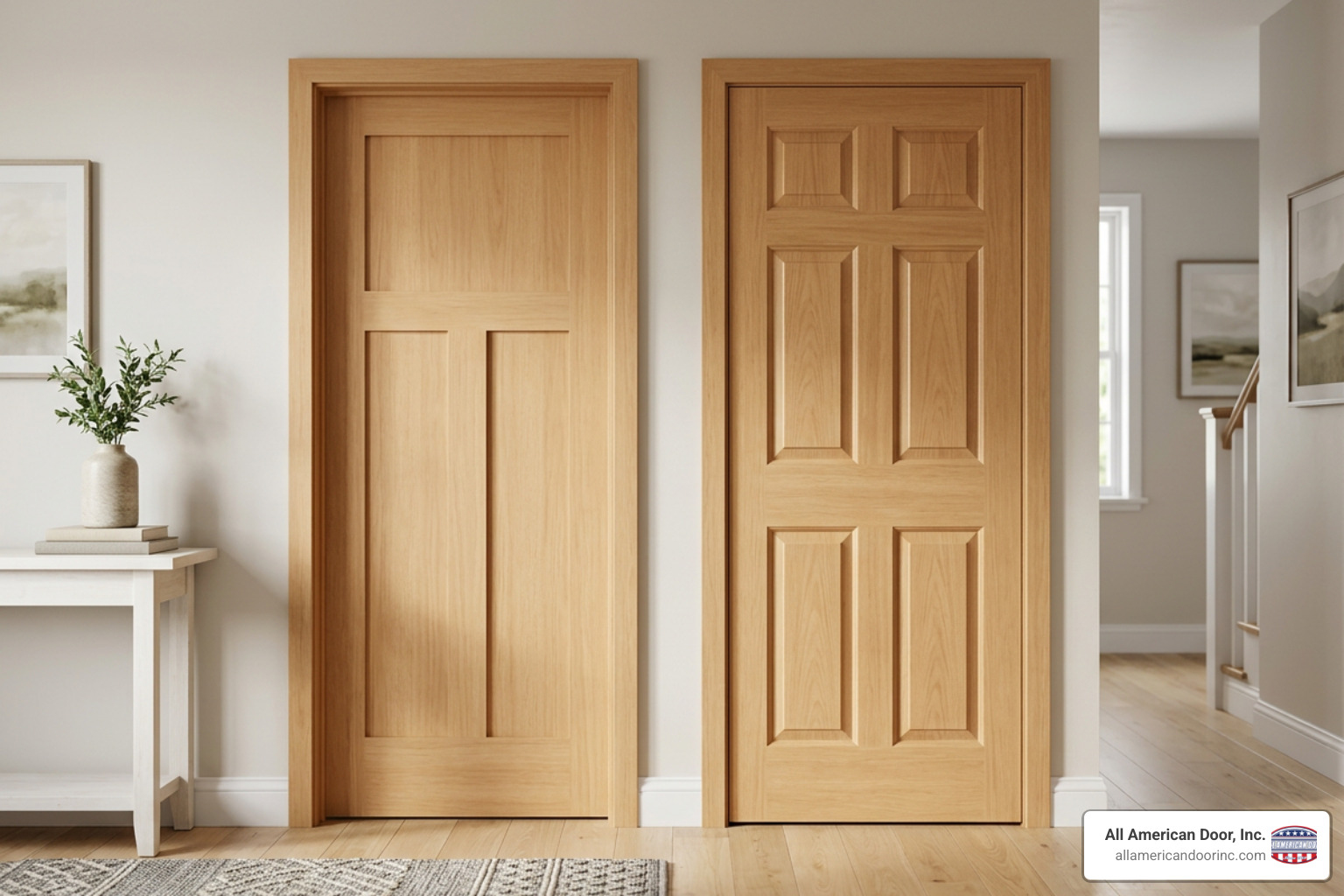
Designing Custom 4 Panel Wood Doors for Your Home
The look of your 4-panel door is defined by its panel profile and “sticking” (the decorative detailing where the stile/rail meets the panel).
- Shaker Style (Flat Panel): Features clean, 90-degree square edges and flat inset panels. Shaker doors are incredibly popular in modern, farmhouse, and minimalist homes because of their simple, shadow-casting lines.
- Raised Panel: The wood panels are thicker in the center and slope down toward the edges. This traditional style adds depth, elegance, and architectural weight, making it a great match for colonial, Victorian, or formal Mediterranean homes.
- Sticking Profiles: You can customize the sticking with options like Ovolo (rounded, classic curves), Ogee (flowing S-curves), or Mission/Square (flat and sharp).
- Glass and Mirror Inserts: For dark hallways, pantries, or home offices, you can swap out wood panels for glass panes (such as true divided lites) or add integrated mirrors on one side of a closet or bedroom door.
If you are thinking about how custom details can elevate your overall home design, take a look at our article on Designing a Custom Front Door That Boosts Security and Style for ideas that translate beautifully to interior spaces.
Sizing and Rough Openings
When ordering doors, getting the measurements right is critical. Standard interior door heights are typically 80 inches (6’8″) or 84 inches (7’0″), with widths ranging from 18 to 36 inches.
To calculate the rough opening (the framed opening in the wall before the door frame is installed), use this standard industry rule of thumb:
- Rough Opening Width: Add 2 inches to the nominal door slab width. (e.g., a 30-inch door requires a 32-inch rough opening).
- Rough Opening Height: Add 2 inches to the door height. (e.g., an 80-inch door requires an 82-inch rough opening). For pocket door frames, you typically need to add 4 inches to the height and double the width plus 1.5 inches.
We also need to consider your jamb width, which is determined by your wall construction. Standard 2×4 wall framing with 1/2-inch drywall on both sides requires a 4-9/16 inch jamb, while 2×6 framing requires a 6-9/16 inch jamb. If you are in the Southern California area and need professional help measuring or installing, you can explore our services at Custom Doors Anaheim CA.
Slab vs. Prehung Options
Should you buy a “slab only” or a “prehung” unit? Here is a quick breakdown to help you decide:
- Slab-Only Doors:
- What it is: Just the wooden door blank itself. No hinges, no frame, no handle prep.
- Pros: Less expensive upfront; perfect if you are keeping your existing, perfectly square door frames and just want to replace the wood.
- Cons: Requires precise carpentry skills to mortise the hinges and drill the lockset hole on-site.
- Prehung Doors:
- What it is: The door comes pre-hung on its frame (jamb) with hinges already installed and the lockset hole pre-bored.
- Pros: Much easier and faster to install; ensures a perfect fit with no sticking or uneven gaps.
- Cons: More expensive; bulkier to transport.
Frequently Asked Questions
What is the typical price range for 4-panel wood doors in 2026?
In 2026, pricing varies widely based on construction, wood species, and customization. Mass-produced pine or molded composite 4-panel doors at big-box retailers range from $150 to $400.
If you step up to high-quality, solid wood or engineered hardwood doors from specialty manufacturers, prices generally start around $595 for paint-grade poplar and can range from $1,000 to over $3,000 for premium stain-grade hardwoods like rift-sawn white oak, walnut, or cherry. Prehung options typically add $300 to $400 to the base slab price.
How do shipping and lead times affect my purchase?
Because high-quality wood doors are heavy (typically weighing between 100 and 150 pounds for a single door), they must be shipped via freight in custom-built wooden crates to prevent damage during transit. Shipping rates across the continental United States generally range from $125 to $425 depending on the quantity of doors ordered and your location.
Standard lead times for custom wood doors are typically 4 to 6 weeks for production, plus transit time. If you order custom jamb kits or specialty finishes, lead times can extend slightly.
Can 4-panel wood doors be used for pocket or sliding applications?
Absolutely! A 4-panel wood door slab makes an excellent pocket door or barn door. When using a 4-panel slab for a pocket door, specialty manufacturers often build the door asymmetrically so that exactly 1 inch of the door remains inside the pocket when fully closed, ensuring a perfectly symmetrical reveal.
Because solid wood doors are heavy, ensure you use heavy-duty commercial-grade track hardware and soft-close mechanisms to handle the weight and keep the door gliding smoothly.
Conclusion
Upgrading your home with 4 panel wood doors is a long-term investment that adds immediate warmth, sound isolation, and architectural value. Whether you prefer the clean, crisp look of a painted Shaker-style door or the rich, natural grain of a stained Douglas fir, choosing the right construction and finishing method ensures your doors will operate smoothly for decades.
At All American Door, Inc., we have spent over 20 years helping homeowners in Fullerton, Orange County, and Lake Havasu City find and install the perfect doors for their budgets. With our hands-on showroom, certified in-house installers, and an A+ BBB rating, we take the stress out of home remodeling.
Ready to transform your home’s interior? Explore our wide selection of Interior & Exterior Doors or contact us today to schedule your custom door consultation!