
Why Hiring Certified Vinyl Window Installers Is the Most Important Decision You’ll Make
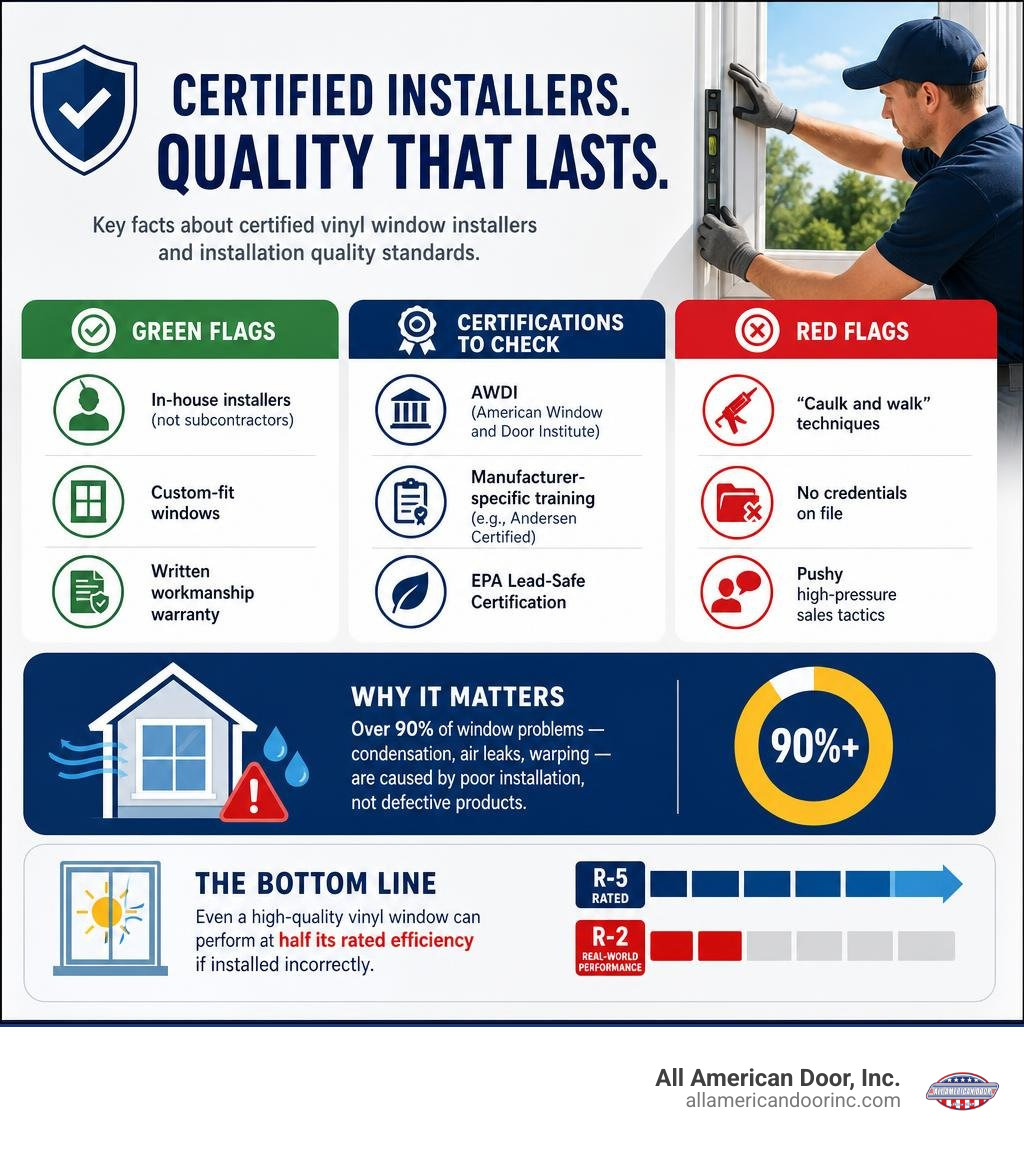
Certified vinyl window installers are licensed, trained professionals who follow recognized industry standards to ensure your windows perform as promised — protecting your home from drafts, moisture, and energy loss.
Here’s a quick overview of what to look for when hiring:
- Certifications to check: AWDI (American Window and Door Institute), manufacturer-specific training (e.g., Andersen Certified), EPA Lead-Safe Certification
- Key green flags: In-house installers (not subcontractors), custom-fit windows, written workmanship warranty
- Red flags: “Caulk and walk” techniques, no credentials on file, pushy high-pressure sales tactics
- Why it matters: Over 90% of window problems — condensation, air leaks, warping — are caused by poor installation, not defective products
- Bottom line: Even a high-quality vinyl window can perform at half its rated efficiency if installed incorrectly
Most homeowners focus almost entirely on the window itself — the brand, the glass package, the frame color. That’s understandable. But here’s what the industry doesn’t say loudly enough: the window is only half the system. The installation is the other half.
A poorly installed window can take an R-5 rated unit and drop its real-world performance to barely above R-2. That’s not a minor dip — that’s a failure. And in most cases, manufacturer warranties won’t cover problems caused by faulty installation. The cost falls entirely on you.
If you’re a homeowner in Orange County dealing with fogging glass, rattling frames, or a skyrocketing energy bill, the culprit may not be the window itself. It may be how it was put in.
I’m Greg, and I’ve helped homeowners throughout Southern California navigate exactly these decisions — let me walk you through everything you need to know before hiring anyone to touch your windows.
Related content about certified vinyl window installers:
Why You Should Hire Certified Vinyl Window Installers
When you invest in home improvement, you expect the results to last. Unfortunately, the window industry is filled with general contractors who treat window replacement as a side gig. They buy standard retail sizes, force them into your existing openings, slap some cheap sealant around the edges, and call it a day.
Hiring certified vinyl window installers ensures that your project is handled by specialists who understand the unique physical properties of polyvinyl chloride (PVC). Vinyl behaves differently than wood or aluminum; it expands and contracts with temperature swings. In the blistering summer heat of Lake Havasu City, Arizona, or the milder coastal climate of Fullerton, California, your windows must be installed with precise tolerances to accommodate this thermal movement without warping or breaking seals.
Certified installation is your only guarantee of workmanship. It means the team on your property is not guessing their way through the process. They are following strict, scientifically verified protocols designed to keep the elements out and the conditioned air in.
What Defines Certified Vinyl Window Installers?
A certified installer is not just someone who has been putting in windows for a long time. True certification requires formal training, testing, and adherence to rigorous industry standards.
When evaluating contractors, look for these specific credentials:
- AWDI (American Window and Door Institute) Certification: This organization establishes rigid guidelines for residential installations. AWDI-certified installers understand how to re-establish all five critical weather barriers between your window and your wall.
- Manufacturer-Specific Certifications: Brands like Andersen train and certify installers specifically on their proprietary product lines. For instance, a manufacturer-certified installer undergoes hands-on training to guarantee ordering accuracy and perfect structural alignment.
- InstallationMasters Certification: Originally developed by the American Architectural Manufacturers Association (AAMA), this program teaches installers the absolute best practices for preventing water intrusion and air leakage.
To understand why these certifications matter so much to the longevity of your window frames, take a look at The Definitive Guide to Vinyl Windows.
Certified Installers vs. Non-Certified Contractors
The differences between hiring a certified specialist and a non-certified general contractor are stark.
Many retail window companies rely on third-party subcontractors. These subcontractors are often paid per window installed, incentivizing them to work as fast as possible. This leads to the infamous “caulk and walk” method, where installers skip crucial cavity insulation and rely entirely on a bead of exterior caulk to block drafts.
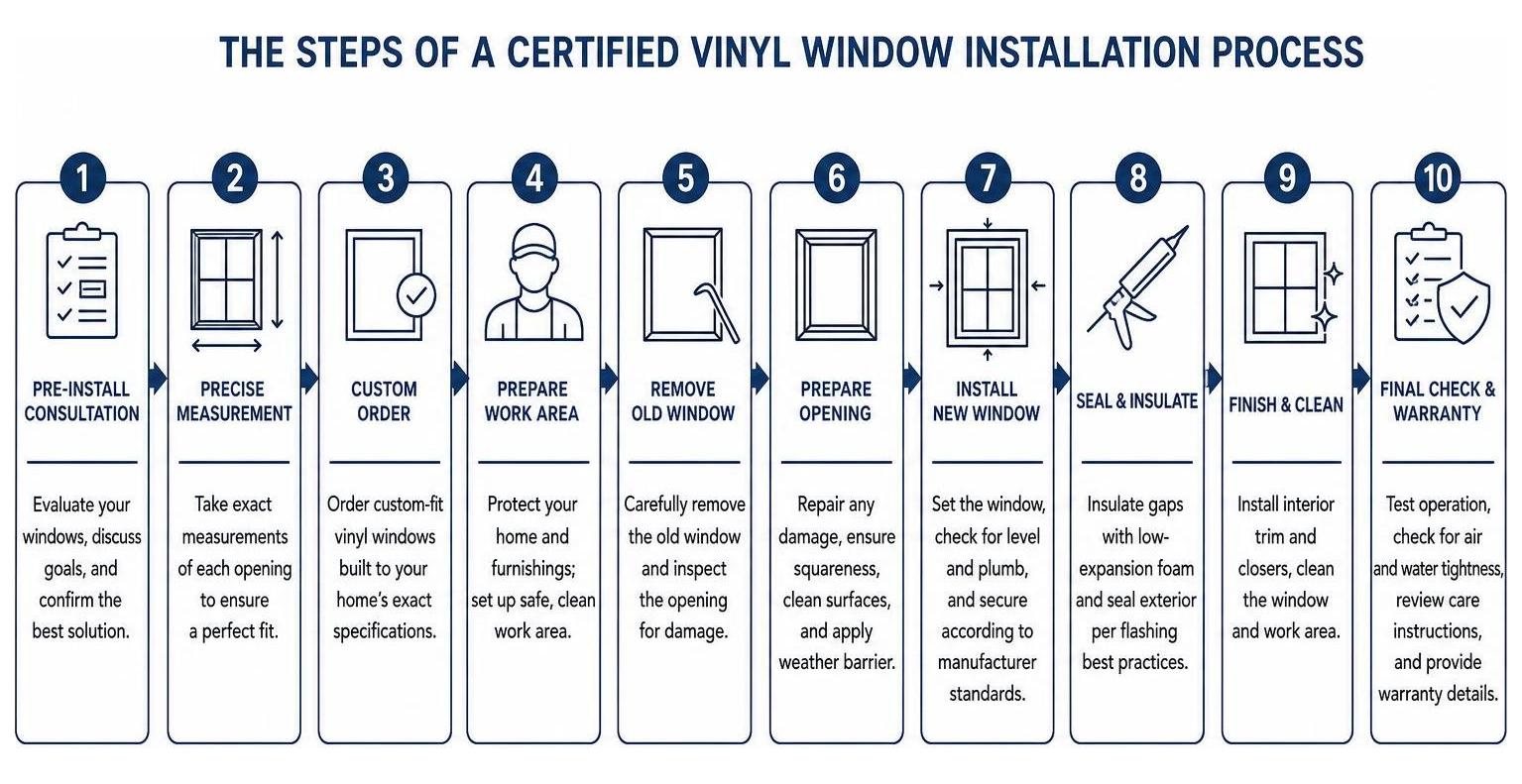
On the other hand, certified installers are typically factory-trained, in-house employees. They follow precise protocols, including:
- Preparing a “consistent opening” that is square, level, and plumb before the window is set.
- Using high-R-value expanding foams and specialized flashing tapes instead of cheap fiberglass stuffing.
- Ensuring the window’s drainage system (weep holes) remains completely unobstructed.
To see how these structural steps protect your home, read more about The Difference Professional Installation Makes for Windows and Doors.
The Cost of Poor Installation: Energy Loss and Performance Issues
The financial impact of a bad window installation is immediate and compounding. You might purchase an energy-efficient vinyl window featuring multi-pane glass, argon gas fills, and Low-E coatings, but if the frame is installed poorly, those premium features are rendered useless.
When a window is not sealed correctly to the building envelope, air drafts bypass the insulated glass entirely. This creates thermal bridging, where heat transfers freely between the outdoors and your living room. In hot desert climates like Arizona or during warm Southern California summers, your air conditioner will run constantly to compensate for this thermal loss, driving up your monthly utility bills.
How Bad Installation Ruins Energy Efficiency
According to industry data from the American Window and Door Institute, over 90% of all window performance complaints are caused by faulty installation rather than manufacturing defects.
When uncertified contractors use “caulk and walk” techniques, the performance degradation is staggering:
- A premium R-5 rated window can degrade to an installed performance of barely over R-2.
- Poor installation can reduce the overall energy efficiency of your new windows by more than 25% compared to their laboratory-tested ratings.
- Standard installation failures can cause a highly rated energy-efficient window to perform worse than the old, drafty windows it replaced.
To protect your investment and avoid these massive efficiency losses, it is vital to work with specialists who understand the science of thermal barriers. Learn more about this by reading Why Professional Installation Is Key for Long-Lasting Windows and Doors.
Common Signs of Improper Vinyl Window Installation
How do you know if your windows were installed incorrectly? Keep an eye out for these common warning signs:
- Persistent Drafts: If you can feel air moving around the edges of the window frame even when the sash is locked tight, the perimeter seal has failed.
- Interior Condensation: Moisture pooling between the window frame and your drywall indicates that warm, humid air is leaking into the wall cavity.
- Difficult Operation: If your vinyl sashes are sticking, grinding, or refusing to lock, the frame was likely twisted or forced into an uneven opening during installation. Over time, this leads to irreversible frame warping.
- Water Leaks: Stains on your drywall or bubbling paint beneath the window sill are clear indicators of improper flashing.
If you suspect your windows are failing, check out our guide on How Proper Installation Extends the Life of Your Windows to see how these issues can be permanently resolved.
Custom-Fit vs. Off-the-Shelf Vinyl Windows
One of the most important decisions you will make during a window replacement project is choosing between custom-fit vinyl windows and standard off-the-shelf retail options.
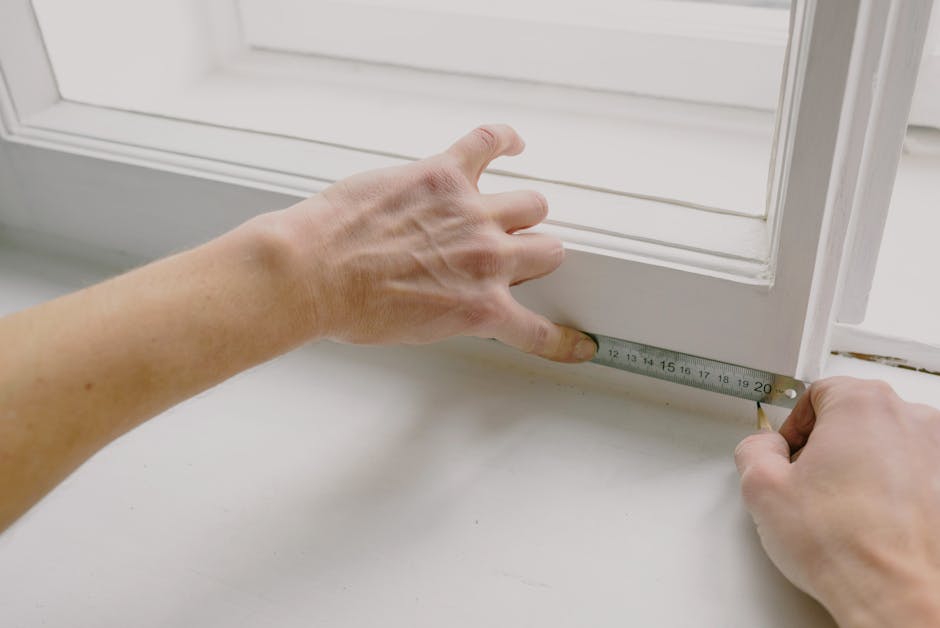
Off-the-shelf windows are manufactured to standard, pre-set dimensions. Because older homes shift and settle over time, your window openings are rarely perfectly square or sized to exact retail standards. To force a retail window to fit, contractors must often make costly structural modifications to your home’s wall framing, which can compromise its structural integrity.
Custom-fit vinyl windows are engineered to the exact millimeter of your existing opening. This precision eliminating the need for messy framing alterations and ensures a tight, seamless fit.
| Feature | Custom-Fit Vinyl Windows | Off-the-Shelf Retail Windows |
|---|---|---|
| Sizing | Manufactured to the exact millimeter of your opening | Standardized retail sizes only |
| Structural Changes | None required; preserves home design | Often requires modifying wall framing |
| Installation Time | Fast and clean (typically 1–2 days for the whole house) | Slow; requires extensive carpentry |
| Sealing Quality | Maximum thermal seal with minimal gaps | Large gaps requiring excessive caulk |
| Warranty Protection | Fully covered by manufacturer and installer | Often voided if modified to fit |
If you want to explore the full range of benefits that custom-engineered vinyl frames bring to your home, read 7 Reasons Why Vinyl Windows Are the Best Replacement Option.
How to Verify and Choose the Right Contractor
Finding a contractor who claims to be certified is easy; verifying those claims takes a little bit of homework. To protect your home and your wallet, you must take an active role in vetting any company you consider hiring.
Verifying Credentials and Warranties
Before signing any contract, ask the company to provide physical proof of their certifications. A reputable team of certified vinyl window installers will gladly show you their credentials.
- Check the Certifications: Ask to see their AWDI or InstallationMasters certificates.
- Verify EPA Lead-Safe Certification: If your home was built before 1978, the EPA requires installation firms to be Lead-Safe Certified to prevent hazardous lead dust from contaminating your living space. You can review the federal requirements through the EPA Lead Renovation, Repair and Painting Program.
- Look at the Warranty Terms: Always distinguish between the manufacturer’s product warranty and the contractor’s installation warranty. Most window manufacturer warranties explicitly exclude coverage for installation errors. A top-tier certified installer will provide a separate, written workmanship guarantee.
For a deeper dive into selecting the best local partner, read our expert advice on Choosing the Right Replacement Window Company.
Questions to Ask Potential Certified Vinyl Window Installers
Before hiring an installer, conduct a thorough interview. Use this quick checklist to ensure they meet professional standards:
- “Do you use certified, in-house installers, or do you hire third-party subcontractors?” (In-house teams offer far greater quality control and accountability).
- “Are your estimates fully transparent, or are there hidden fees for debris disposal and cleanup?” (Look for companies that offer straightforward, low-pressure quoting with no hidden surprises).
- “How do you handle insulation around the window frame?” (They should explain their use of low-expansion foams and weather barriers, not just caulk).
- “Can I visit your local showroom to see the products in person?”
Frequently Asked Questions about Vinyl Window Installation
How long does vinyl window installation take?
For most standard residential projects in Southern California or Arizona, a professional, certified crew can complete the entire installation in one to two days. Because the windows are custom-fit to your openings, the actual physical swap is fast, efficient, and minimally disruptive to your daily routine.
Are installation errors covered by manufacturer warranties?
No. This is one of the most common surprises for homeowners. If your window leaks, warps, or develops condensation between the panes due to improper installation, the manufacturer’s product warranty will not cover the cost of repairs or replacements. This is why hiring a certified installer who provides a dedicated workmanship warranty is so critical.
Can vinyl windows be repaired or must they be replaced?
Minor issues like broken locks, damaged balance systems, or cracked glass panes can often be repaired by a specialist. However, if the vinyl frame itself has warped, cracked, or bowed due to structural pressure from a bad installation, the entire window unit must be replaced. To learn more about the physical properties of vinyl and when replacement is necessary, consult with a certified window professional who can assess the structural integrity of your frames.
Conclusion
At the end of the day, your home deserves the best protection possible. Investing in beautiful, high-efficiency vinyl windows is a smart choice, but only if they are installed with the precision and care that certified professionals provide.
At All American Door, Inc., we are a family-owned and operated company with more than 20 years of local service in Fullerton, CA, Orange County, and Lake Havasu City, AZ. We maintain an A+ rating with the Better Business Bureau because we do things differently:
- We use certified, in-house installers — never third-party subcontractors.
- We operate a hands-on local showroom where you can touch, operate, and compare products before making a decision.
- We provide honest, straightforward advice tailored to our local climates, and we never work on mobile homes, focusing entirely on high-quality, standard residential properties.
If you are ready to upgrade your home’s comfort, beauty, and energy efficiency, we are here to help. Explore our selection of high-performance Vinyl Windows or contact us today to schedule your consultation.